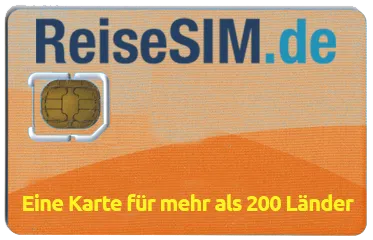
ReiseSIM Prepaid SIM Card for São Tomé and Príncipe incl. €10 credit
SIM card

For São Tomé and Príncipe we offer the ReiseSIM Global with €10 starting credit for €24.90. You get an Estonian number and additionally a German number where family and colleagues can reach you. Outgoing calls cost €1.25 per minute, incoming calls to the Estonian number €0.85 and to the German number €1.00 (price for incoming calls plus €0.15 surcharge). Incoming SMS are free, an SMS home costs €0.55.
Important: Mobile internet with ReiseSIM in São Tomé and Príncipe is very expensive (€20.00 per MB) – so switch off mobile data and use Wi-Fi in the hotel. For messengers, emails and video calls, it's best to use the Wi-Fi in hotels and restaurants. Even with a German mobile contract there is no EU roaming.
| Criterion | ReiseSIM Global SIM |
|---|---|
| Function | Telephony & Internet |
| SIM format | SIM (3-in-1) |
| Outgoing calls from São Tomé and Príncipe (per minute) | €1.25 |
| Incoming calls (international number) | €0.85 |
| Incoming calls (German number) | €1.00 |
| Outgoing SMS | €0.55 |
| Incoming SMS | Free |
| Data packages in São Tomé and Príncipe | NO |
| Mobile internet without package (per MB) | €20.00 |
| Internet speed in São Tomé and Príncipe | depending on partner network |
| Network/provider in São Tomé and Príncipe | local partner network (automatic network selection) |
| Frequencies (important for device compatibility) | typical for the country |
| Special features | Estonian number + additional German number, €10 starting credit |
| Go to offer | Order ReiseSIM prepaid SIM card for São Tomé and Príncipe |
São Tomé and Príncipe is, after the Seychelles, the smallest state in Africa. The two main islands of volcanic origin lie in the Gulf of Guinea, around 250 kilometres off the coast of Gabon, almost exactly on the equator. Rainforest, cocoa plantations and lonely beaches make the country a quiet destination away from mass tourism. Here you will find everything important about SIM cards, calls and internet in São Tomé and Príncipe, as well as about the country, people and safety.
Around 230,000 people live on the islands, the vast majority on São Tomé; Príncipe is much smaller and even quieter. The official language is Portuguese – the country was a Portuguese colony until 1975. Creole languages such as Forro are also spoken. The motto of life is “leve-leve” – always take it easy. English is not widely spoken, a few words of Portuguese help a lot.
The local currency is the Dobra (STN), which is pegged to the euro: €1 equals 24.5 Dobra. Euro cash is accepted in hotels, restaurants and many shops and can be exchanged without problems. Credit cards are only accepted in a few larger hotels, and ATMs for foreign cards are rare.
What lands on the table is mainly fresh fish, along with plantains, breadfruit, cassava and taro. The national dish Calulu is a long-simmered stew of fish or chicken with herbs and palm oil. And of course cocoa: at the start of the 20th century the islands were one of the world's largest cocoa producers, and today high-quality chocolate is made there.
The culture blends Portuguese and African traditions. Well known is the Tchiloli, a folk theatre based on a medieval knightly legend, performed in magnificent costumes. People are friendly and reserved; a greeting and a short chat are part of the ritual before getting down to business.
Those who bring time and patience experience the islands at their most relaxed. The infrastructure is simple, and roads in the south and north are partly in poor condition.
São Tomé and Príncipe is considered one of the safest countries in Africa, and violent crime is rare. Even so, you shouldn't show valuables openly. Important for your health: there is a malaria risk, and medical care is limited. Before travelling, get travel-medical advice on vaccinations and malaria protection.
The equator runs directly over the tiny island of Ilhéu das Rolas south of São Tomé – there you can stand with one leg in the northern hemisphere and the other in the southern hemisphere. The landmark of the main island is Pico Cão Grande, a needle-shaped volcanic column that rises around 300 metres steeply out of the rainforest.
In the capital and the larger towns on São Tomé reception is decent; in the south, in the rainforest and on Príncipe there are dead spots. Many hotels and restaurants have Wi-Fi, though it can be slow – plan downloads and video calls accordingly.